Mythos finds the bugs.
Konvu proves which ones are exploitable.
Send Konvu what Claude Mythos, Daybreak, Codex Security, XBOW or your own harness reported. For each finding, Konvu deploys your app in an isolated sandbox, attacks it from a separate machine and tells you which ones an attacker can use, with the requests and responses as proof. Exploitable findings come with a remediation plan.
Send findings with the Konvu CLI, the API or a file upload. Konvu never trains models on your data.

Findings from
 Claude MythosAnthropic
- Claude SecurityAnthropic
 DaybreakOpenAI
- Codex SecurityOpenAI
 XBOW
 CodeMenderGoogle
- Your own harness
A real bug is not always an exploitable one
AI scanners are often right about the code. The app you ship can still stop the attack.
A middleware answers first
403 from requireMembership()The feature is off
exports_v2: falseThe role is admin-only
requires role: admin
How Konvu triages a finding
- 01
Send the findings
From the CLI, the API, your coding agent or an upload. Markdown, JSON, SARIF and PDF all work, and a multi-finding export splits into one report per finding.
- 02
Drop the noise first
A fast pass on your code sets aside findings about endpoints or functions that do not exist, groups duplicates by root cause, and checks whether main already changed the code.
- 03
Deploy your app
Konvu Agents build the application from your repository, configure it to the finding's preconditions and seed what the attack needs: two organizations, two users, the records one of them should never see. Cloud services run as open-source stand-ins, like Postgres for RDS.
- 04
Attack it
An attacker agent on a separate machine, which can only reach the sandbox, replays the report's proof of concept. It gets a browser when the attack needs one, and a victim agent when someone has to click a link.
- 05
Read the verdict
Reproduced, Hardening, False positive or Inconclusive, with the requests and responses that decided it. Hardening is a real bug an attacker cannot use, with the precondition that stopped the attack.
- 06
Fix it with the plan
Each exploitable finding gets a remediation plan: the root cause, the change, the test to add, and a prompt ready for Claude Code or Codex. Konvu then runs the exploit against the fix.
Three ways to send findings
konvu finding vulnerability-report submit \
  --repo github:acme/web \
  --source mythos \
  --file findings.sarif
Tag the source to filter by it later.
> Send the Mythos findings in findings.sarif to Konvu for acme/web.
Claude Code or Codex runs the Konvu CLI for you once you have logged in.
Upload the export file in Konvu.
No install needed.
Your app, deployed and attacked for each finding
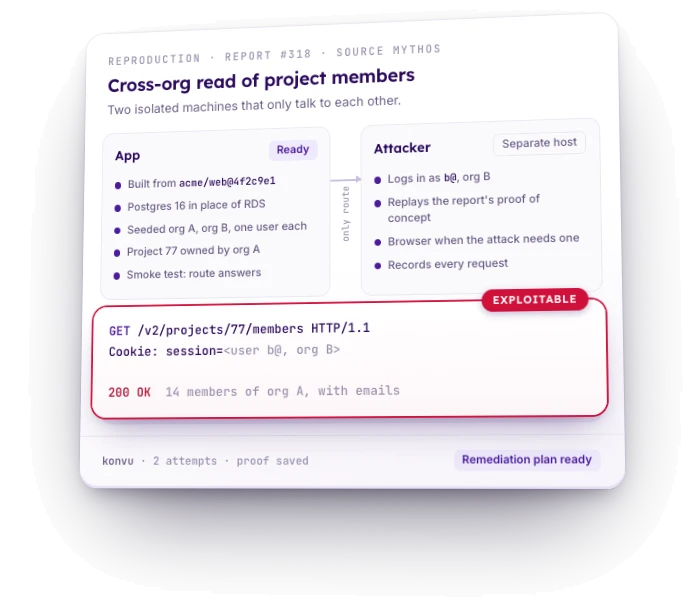
Each finding gets two machines. One runs a copy of your application built from the repository, configured and seeded for the attack. The other runs the attacker, and the two only talk to each other. Nothing runs against your production.
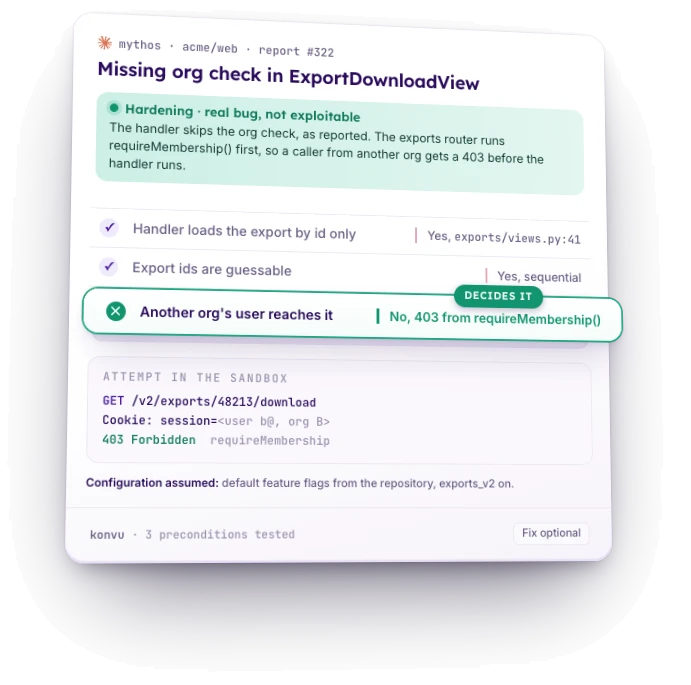
Real bug, not exploitable, and why
Konvu marks these Hardening, and the verdict names the precondition that stopped the exploit: the middleware that answered 403, the flag that was off, the role the attacker could not get. When the attack depends on configuration outside the repository, like a LaunchDarkly flag or roles stored in a database, the verdict says which configuration Konvu assumed.
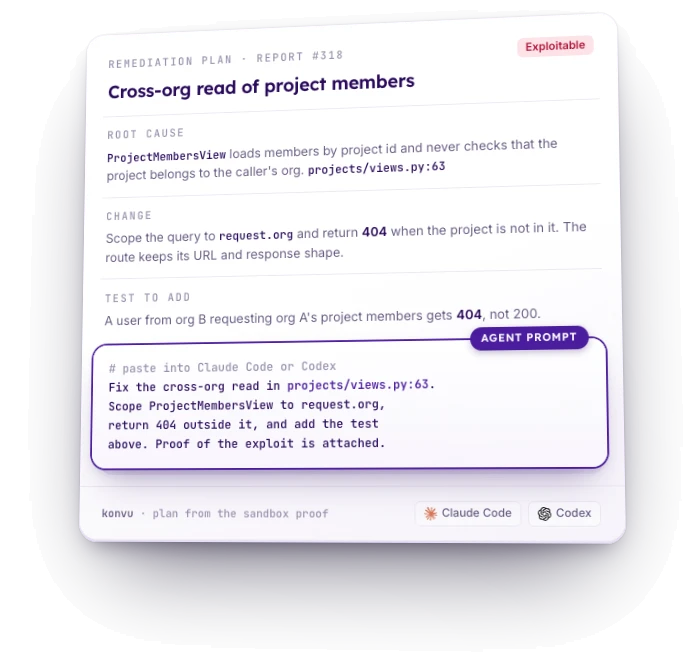
From proof to fix, without a ticket thread
For every exploitable finding, Konvu writes the remediation plan from what the sandbox proved: the root cause in your code, the change that closes the exploit, the test that keeps it closed, and a prompt your coding agent can run. Your team reviews it, or hands it straight to Claude Code or Codex. Once the fix is on a branch, Konvu runs the exploit again to confirm it no longer works.
More accurate on your apps with every run
Deployment lessons
What the agents learn while deploying your app is saved and reused, so later runs on the same app deploy faster. Add your own deployment notes as Markdown.
Threat profile
What your app exposes and to whom. Konvu drafts it from your domain and your code, and you edit it.
Triage rules
Instructions like "this behavior is by design", in Markdown. Every verdict follows them.
Start with your Mythos findings
Enter your company domain and Konvu drafts your threat profile. Then connect the repository and send the findings with the CLI, the API or an upload.