Your scanner matched a pattern. Konvu follows the data.
Static analysis rules match the shape of code, which is why they fire on code nobody can attack. Konvu traces the untrusted value from the parameter that carries it to the sink that consumes it, checks every guard in between, and dismisses what cannot be reached.
Fewer false positives
Validate which SAST findings have exploitable data flows in your actual codebase.
Evidence for every decision
Audit-ready reasoning for every dismissed finding. No suppression rules.
Developer trust restored
When developers only see real issues, they stop ignoring security findings.
Works with your SAST tool
Ingests findings from your existing static analysis tools. No replacement needed.
What a proved code finding looks like
A finding in your own code, traced from the entry point to the sink, with the reasoning that made it exploitable recorded against each condition.
Most SAST findings die mid-flow
A rule matches shapes in code, which is why it fires on code that cannot be attacked. Konvu traces the untrusted value from the parameter that carries it to the query that consumes it, and checks every guard in between.
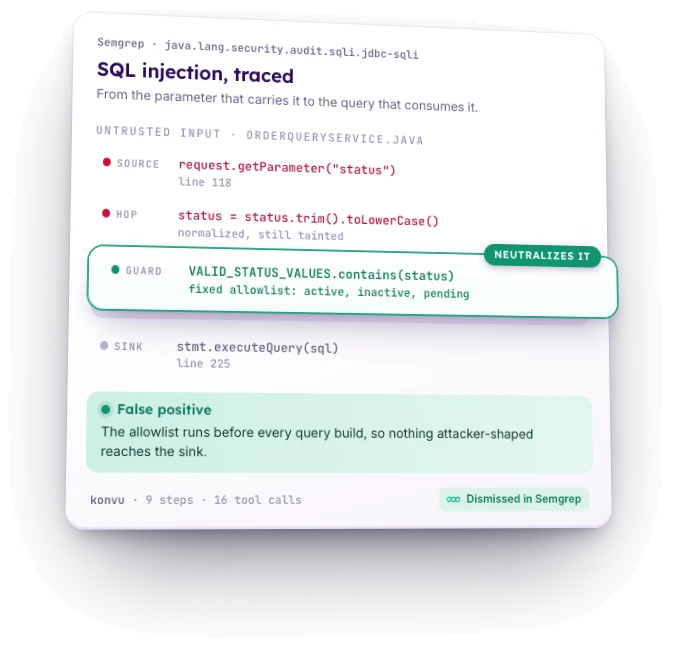
A verdict your developers will believe
Suppression rules ask a developer to trust a decision with nothing behind it, so they stop trusting the queue. Every Konvu verdict names the file it read, the line the decision turns on, and the guard it found or the one that is missing.
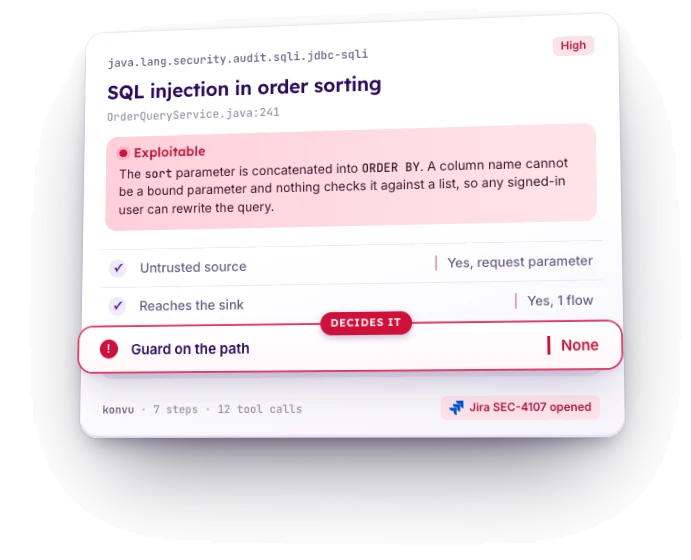
Get started in minutes
Connect your existing SAST tools and source code. No scanners to replace, no workflows to change.
Connect or upload from your SAST tool, and connect your source code repository
Konvu analyzes findings for exploitability with evidence
Dismissals you approve write back to scanners that support it
Go deeper
Why Can't We Just Use Claude for This?
Four things a generalist frontier model will not give you on vulnerability triage, and what we built instead.
Read
Detecting Exploitable Vulnerabilities at Runtime
Using Java dynamic instrumentation to see which vulnerable code actually executes, rather than which code exists.
Read
SCA vs SAST: What Each Tool Actually Does
Vendor-neutral comparison. What each tool detects, where they overlap, and how to build a practical AppSec toolchain.
Read