Your security guidelines, followed by every coding agent.
Checked in agent hooks or CI.
More code, from more people who never read your security guidelines. Konvu drafts the checks from your code and context. The coding agent follows them as it writes, and CI runs them before merge.
Free trial. SOC 2 Type II. Code never stored by Konvu or model providers, never used for training. GitHub access: read code and metadata, write pull request comments.
Who writes code has changed. The guidelines did not move.
More code, from more people
Engineers ship more with coding agents. PMs, designers, and support engineers open pull requests too.
The guidelines exist
Every read scoped to the caller's organization. Role changes admin-only. Refunds keep their approval step. All of it in wikis, threat models, and the AppSec team's heads.
Nobody writing the code reads them
A new engineer skims them once. A PM prompting Claude Code never sees them. The agent does not know they exist.
Review cannot close the gap
Review capacity is flat while change volume grows. Violations surface late, from a reviewer who happened to look, or the next pentest.
Konvu writes down the rules your application already relies on
Point Guardrails at a repository and share what you have: architecture docs, a threat model, pentest reports, past findings. It maps assets, actors, trust boundaries, and controls, then drafts the rule behind each control, linked to its source. The product calls these security invariants.
Download the Guardrails datasheet (PDF)→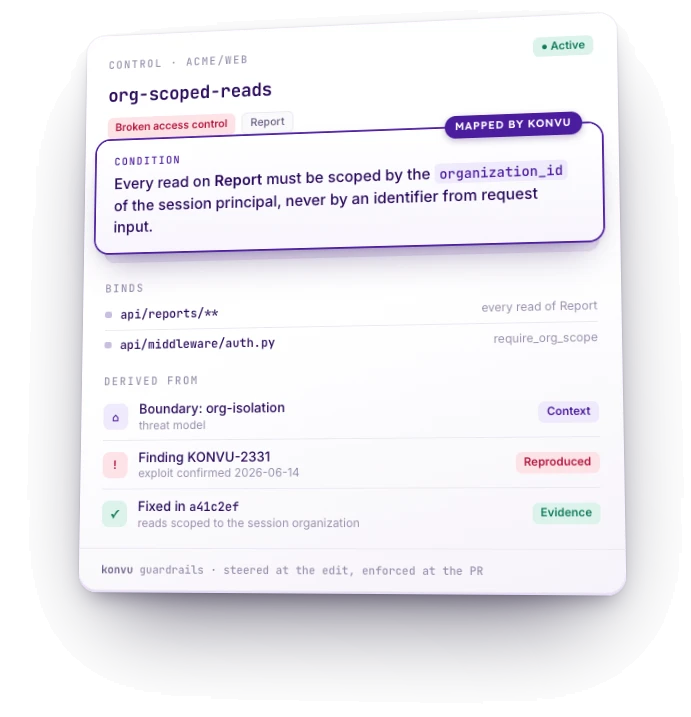
You edit them, reject them, and add your own
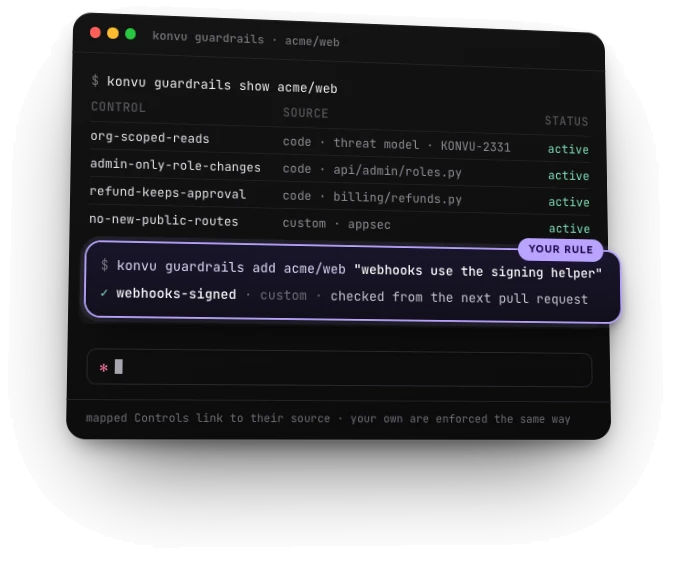
Edit the ones that read wrong, reject the ones you disagree with, and add the rules only your team knows, in plain language: no new route without the session middleware, every change under billing keeps the approval step. Custom rules are enforced like drafted ones. The rules stay yours.
The agent follows the guideline. The person prompting never has to read it.
A deterministic hook decides whether a change touches a rule. When it does, the agent in Claude Code, Codex, or Cursor gets that rule and its evidence through the konvu CLI or MCP, and fixes the change before review. Senior engineer, new hire, PM, or unattended agent: same rule, same check.
Why coding agents miss business-logic vulnerabilities→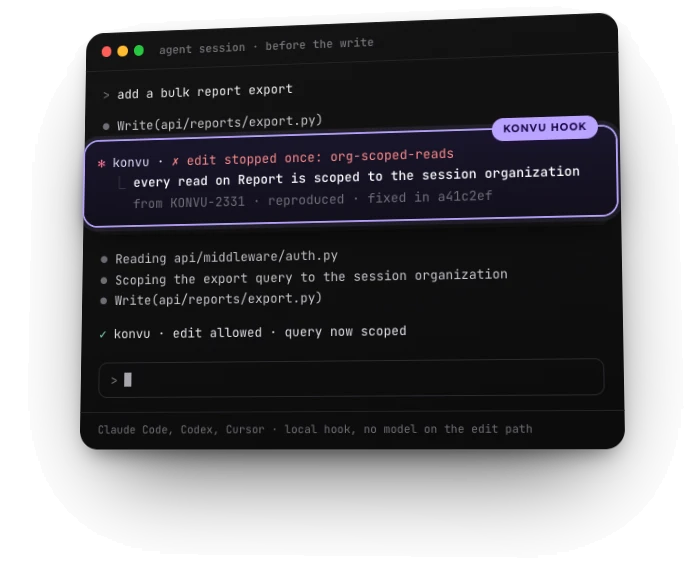
Every pull request checked. Every finding decided.
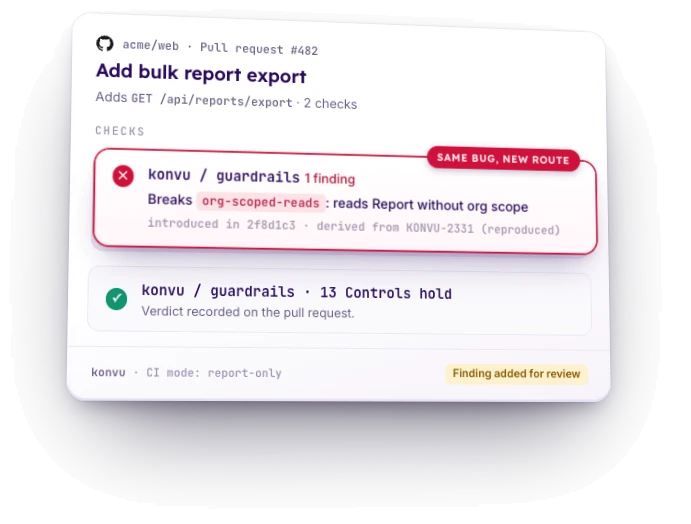
CI checks every pull request against the same rules, report-only or blocking, including code written by hand. Hooks and CI are independent. A broken rule gets fixed. New access no rule covers yet is allowed, which records it as a rule, or denied. The decision lands on the pull request.
Every bug you already paid to fix becomes a rule
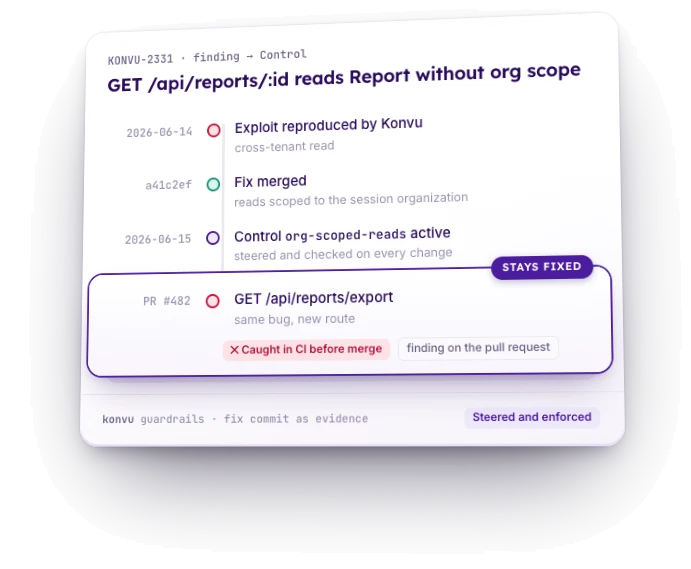
A pentest finding, or an exploit Konvu reproduced, becomes a rule with the fix commit as its evidence. The same bug cannot come back in a new endpoint, whoever writes it.
Alongside your agents. Instead of a rules file.
A SECURITY.md or AGENTS.md
Advice the agent may ignore. It loads into every session, goes stale, and nothing checks it was followed.
SAST custom rules
Semgrep and CodeQL can express a missing tenant check, if someone writes the rule per service and keeps it current. Konvu drafts it and keeps it current.
An AI reviewer
A per-PR opinion without your threat model or a recorded decision. Guardrails checks the same rules every time and records the decision.
Your scanner stays
Scanners find dangerous calls and known patterns. Guardrails checks that your guidelines hold. Run both.