AI security code review
that catches the PR that completes an exploit.
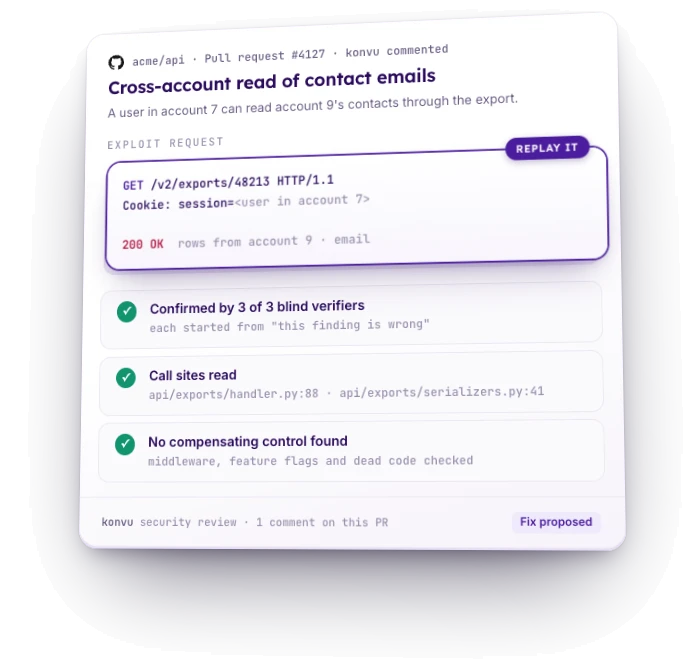
Konvu reviews every pull request, from engineers or coding agents, against what it knows about your service: which account owns the data, the findings it kept and the security rules your team agreed on. It comments only when it can attach the request that exploits the finding.
14-day free trial. No credit card. SOC 2 Type II. Code never stored by Konvu or model providers, never used for training.

What it catches
Lows that chain into an exploit
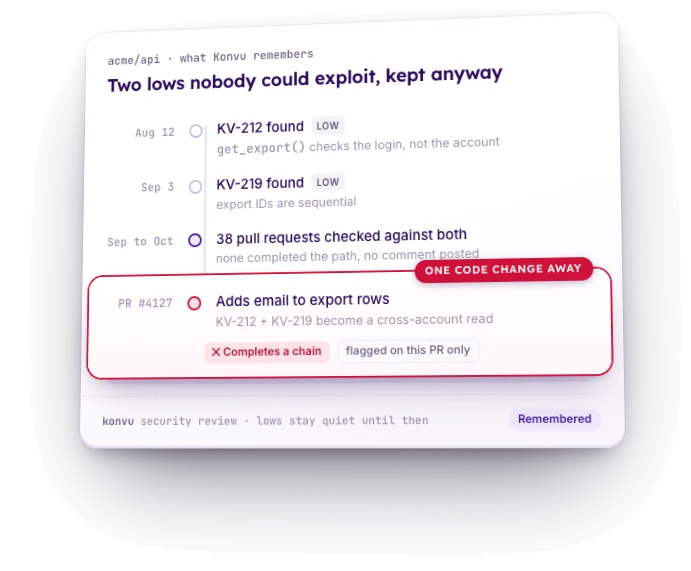
Two findings that are low impact alone, and the pull request that connects them.
One flaw behind many endpoints
A shared helper skips the tenant check and 15 endpoints inherit it. You get one finding and one fix, not 15 comments.
An endpoint that skips the ownership check
Tests pass and the AI review is clean, but the new endpoint never checks which account owns the invoice.
An approval anyone can grant themselves
A handler trusts the approval status the client sends instead of the server's record, so any user can approve their own refund.
How it differs from an AI code reviewer
Keep your AI code reviewer for everyday bugs. Konvu adds the context and the memory it does not have.
Konvu checks every pull request against the findings it kept
Konvu stores every finding it makes, including the low and medium ones that are not exploitable today, and checks each new pull request against them. When a change completes the path, you get one comment on that PR: the chain, the findings it links, and the request that exploits it. Until then, the lows stay quiet.
Konvu knows your service before it reads the diff
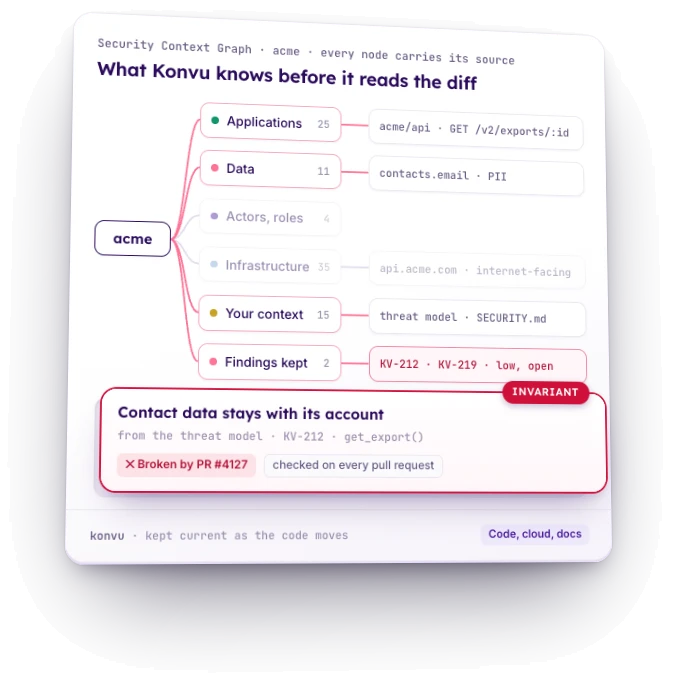
Konvu maps which account owns the data, which role may act, which data is sensitive and what is internet-facing. It builds this Security Context Graph from your code, cloud, CI, docs, threat models and pentest history, and keeps it current as the code changes.
Verifiers try to disprove each finding before you see it
Independent verifiers start from the assumption that the finding is wrong. They re-read the source, cite the call sites, and check for compensating controls, feature flags and dead code. High-severity findings get several blind votes. What survives comes with the exploit path from the public edge and a request you can replay.
Every pull request checked against the rules your team agreed on
Konvu checks each pull request against your Controls: every read scoped to the caller's organization, role changes admin-only, refunds keep their approval step. Guardrails gives a coding agent the same Controls at the edit. This check enforces them before merge, on code written by hand too. Make it required and a failing check blocks the merge. Leave it optional and it reports.
How Guardrails steers the coding agent →