95% less noise
Dismiss non-exploitable dependency findings in bulk, each with documented evidence.
Evidence for every decision
Audit-ready reasoning for every dismissal. No black-box scores.
Faster MTTR
Surface the critical vulnerabilities immediately so teams fix what matters first.
No workflow changes
Approved dismissals write back to supported scanners, and fix pull requests open in GitHub or GitLab.
What a closed dependency finding looks like
A moderate-severity CVE in a Maven dependency, assessed against the five exploitability conditions and closed with the answer to each one recorded.
Walking the paths is the easy half
A scanner reports that a vulnerable package is present. Konvu walks every path from your manifest to the vulnerable symbol, then asks the question the path cannot answer on its own: does anything attacker-controlled actually arrive there?
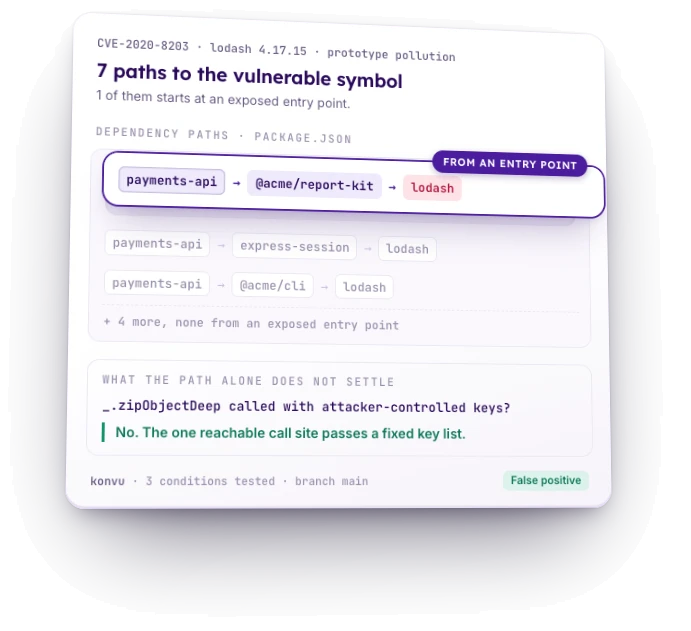
A decision your auditor can check
Every decision arrives with the conditions that were tested, the answer to each one, and the condition that settled it. Retrievable long after the engineer who would have remembered it has moved on.
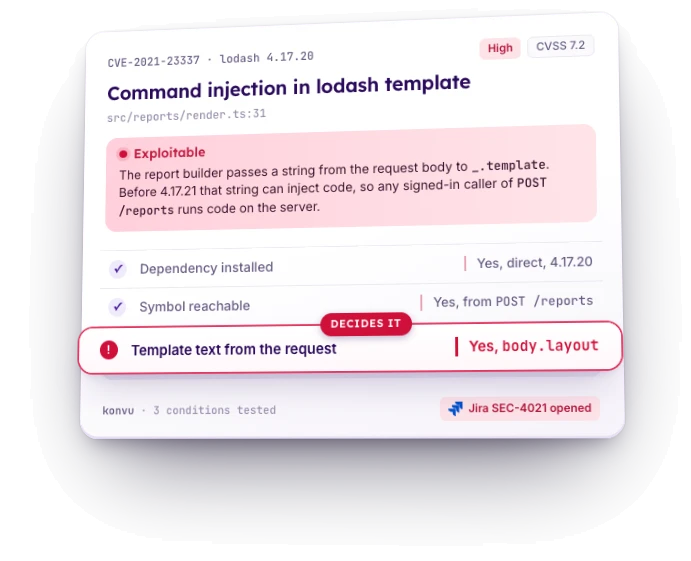
Get started in minutes
Connect your existing SCA tools and source code. No scanners to replace, no workflows to change.
Connect your SCA tool or send its results through the API, and connect your source code repository
Konvu analyzes findings for exploitability with evidence
Dismissals you approve write back to scanners that support it
Go deeper

The False Positive Tax on Open Source
We forked Metabase, enabled Dependabot, and found 53 vulnerabilities. Every single one was a false positive.
Read
Reachability Is Not Exploitability
A call graph says a function can be reached. It does not say an attacker can reach it, which is the question that decides the ticket.
Read
Navigating the Maze of Maven Dependencies
Maven picks the closest declaration, not the newest version. How transitive conflicts happen and how to trace them.
Read