I went to RAISE as a scout, not a buyer
RAISE Summit took over the Carrousel du Louvre for two days in July, and I went with one job: not to sell, not to hire, just to figure out where the field's attention actually is - and where it isn't.
That second part turned out to be the interesting one. The gaps in a conference agenda tell you as much as the headliners.... And the gap at RAISE was loud.
Where the room's attention actually was
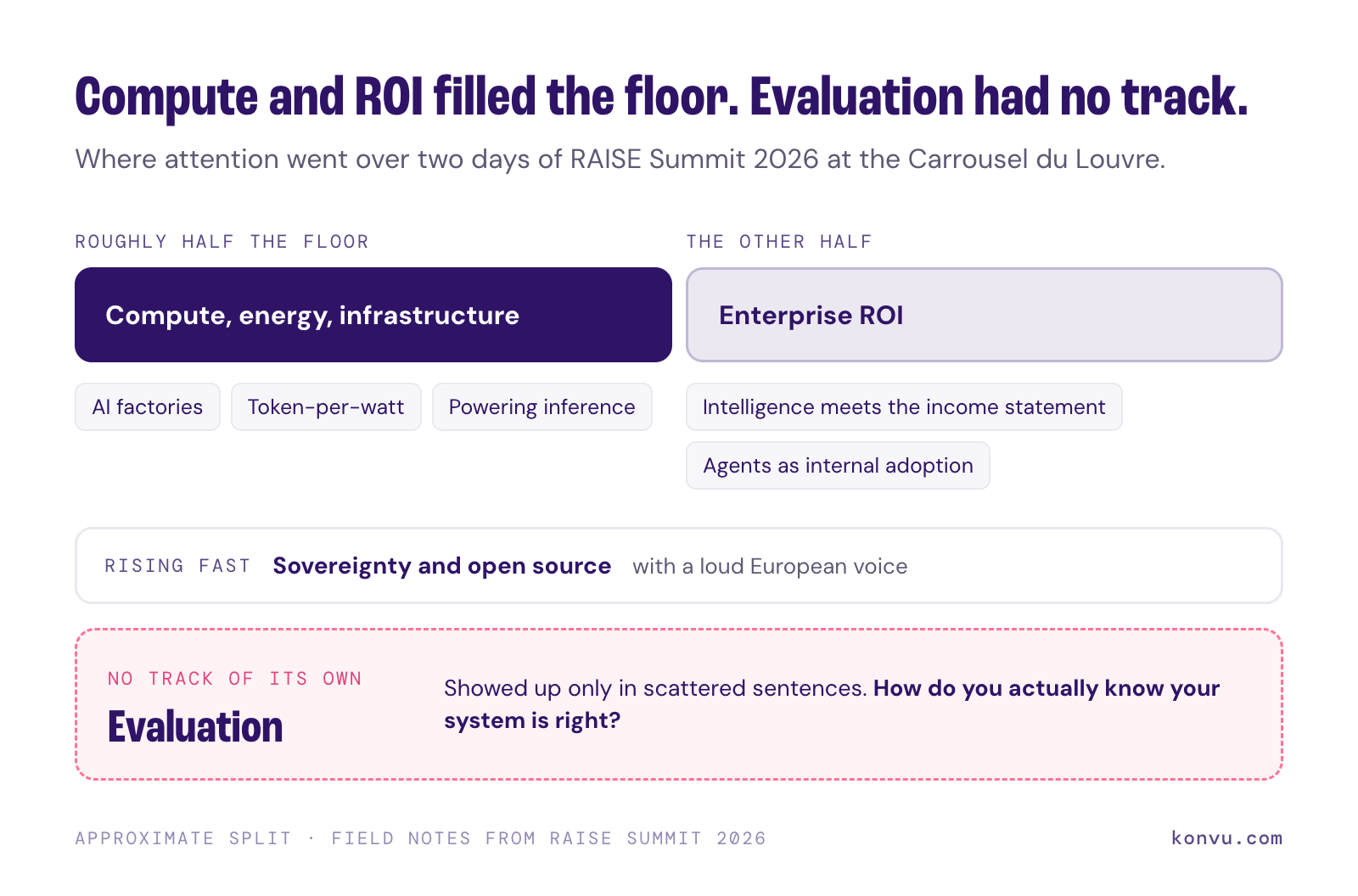
Roughly half the floor was compute, energy, and infrastructure. AI factories, token-per-watt, the "21st-century Manhattan Project" of powering inference. The other half was enterprise ROI: is intelligence finally meeting the income statement?
Agents in production were the hot topic, but mostly framed as internal adoption. How to get the whole company using AI, not how to ship an agent as a reliable product. Sovereignty and open source were rising fast, with a notably loud European voice.
One theme had no track of its own, showing up only in scattered sentences: evaluation. How do you actually know your system is right? That absence is the whole reason this post exists.
Europe is in the race everywhere except raw compute
I'll admit I'd underestimated this. On models, open source, and sovereignty, Europe was genuinely present: Mistral, Hugging Face, Black Forest Labs, H Company. The field is tighter than the "US runs away with it" narrative suggests.
The one place Europe clearly lags is silicon, and the American vendors are happy to remind you. One US infrastructure chairman said, more or less, that there's no Nvidia anywhere else and that European regulation keeps you "orders of magnitude below the scale we can operate at." Tone-deaf, but not entirely wrong on the compute point. Everywhere else, the gap is smaller than the marketing implies.
Evaluating a companion is not evaluating a product
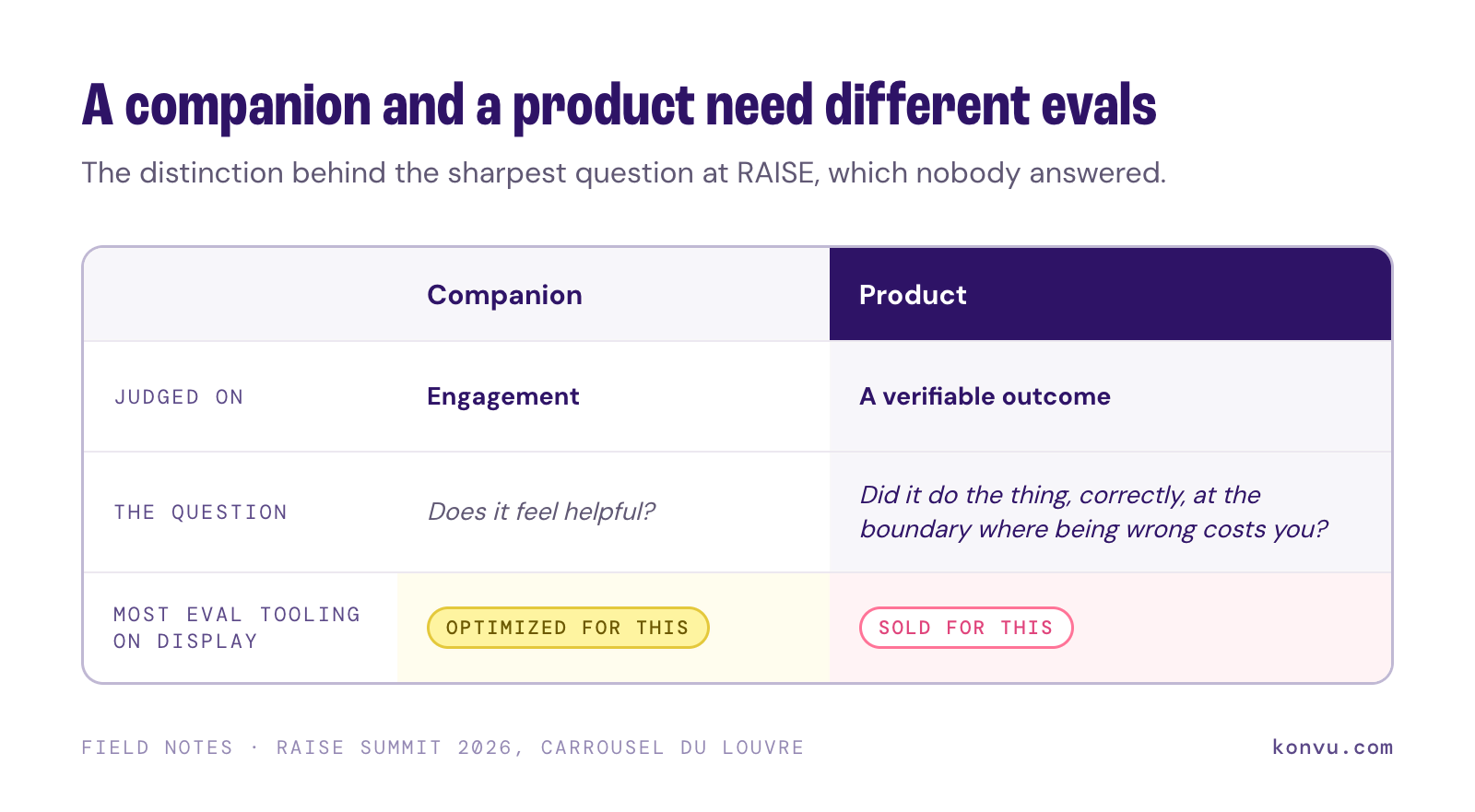
The sharpest question of the whole summit was asked almost in passing, during a talk on frontier code models: does a benchmark tell us whether a model is a good coding companion, or a good agent for the product you're actually selling?
Nobody answered it. But it names a distinction the industry keeps blurring:
- A companion is judged on engagement, e.g., does it feel helpful?
- A product is judged on a verifiable outcome, e.g., did it do the thing, correctly, at the boundary where being wrong costs you?
Those are different evaluation problems. And most eval tooling on display was quietly optimizing the first while being sold for the second. This is the part that maps directly onto our work: when the AI is the product, you need evaluation that bounds uncertainty on a real outcome, not a vibe.
The less you trust the agent's reasoning, the more viable you are
If there was one conviction the strongest talks kept circling, it was this: free-form agent reasoning is a liability you want to minimize, not a feature you want to maximize.
OpenRouter, sitting on 750 trillion tokens of real traffic, put it plainly: you don't cut cost and gain reliability by chasing the newest model: you do it by maturing the harness. The scaffolding around the model carries the value.
Even Cognition, whose entire pitch is autonomous engineering, showed a remediation flow that fixes one vulnerability at a time with heavy human validation at each step. The flashiest agent shop in the building does not hand the wheel to unbounded reasoning.
That's the principle we build on at Konvu: externalize reasoning into deterministic control flow, and turn each model call into a bounded, verifiable task. It isn't free (you trade some of the model's open-ended flexibility for something you can actually check), but verifiability is what lets you put an agent in front of a customer and sleep at night. Determinism is the moat.
The best security talk was really about determinism
My highlight was Kavitha Mariappan's keynote for Rubrik, "The Uncomfortable Math of Frontier AI in Production." Her framing: the new attacks carry no detectable intent, just adversarial inputs that force a chosen output and transfer across models. Deterministic attacks against probabilistic defenses is not a fair fight.
Her conclusion reframes the goal. The question shifts from "will you get breached?" to "can you recover to a known-good state when you do?" She noted that most companies breached last year were fully compliant — because the rules were written for the previous paradigm.
That "known-good state" landed for me, because it's the security-side name for something we already lean on: checkpoint-anchored ground truth. Verifiable checkpoints you can always fall back to. Resilience and determinism turn out to be the same idea seen from two directions.
The quotes that stuck
A few lines I wrote down and kept thinking about:
- Yann LeCun (AMI Labs): "We have LLMs that pass the Turing test, but no robot as smart as a cat". His usual argument for world models — and yes, the object-falling-off-the-table example made its return.
- Chris Clark (OpenRouter): "Token-maxxing is a thing of the past." Cost control comes from the harness, not from always grabbing the newest, biggest model.
- Manoj Nair (Snyk): "Open-source models will reach frontier-tier capabilities in a matter of months". Whether or not the timeline holds, the AppSec implications are real.
- Mark Surman (Mozilla): "we've seen a private company as powerful as Anthropic before — it was the East India Company". A one-liner about concentrated private power that reframed the entire sovereignty debate. (For the curious: private army, ran a subcontinent, ended badly.)
Takeaway: the blind spot is the opportunity
The whole floor was chasing compute and ROI. Both matter. But the thing nobody gave a track to (verifiable evaluation, and designing systems so you depend on the agent's reasoning as little as possible) is exactly the thing that decides whether an AI product is trustworthy enough to ship.
That's a comfortable place to be standing when you're building in it already. The room was looking at the fuel and the finances. The interesting problem was sitting quietly in the blind spot.